Rebuilding a Future
The federal government suspended (but did not officially repeal) Executive Order 9066 in January 1945, beginning the process of closing down the camps and allowing Japanese Americans to return to the former exclusion zone. Some Japanese Americans who had resettled out of the camps remained in new communities, mainly in midwestern cities, but most attempted to return to their original homes. They faced significant difficulties in doing so: most had lost property, totaling over 400 million dollars' worth, and were subject to continuing discrimination from their neighbors.
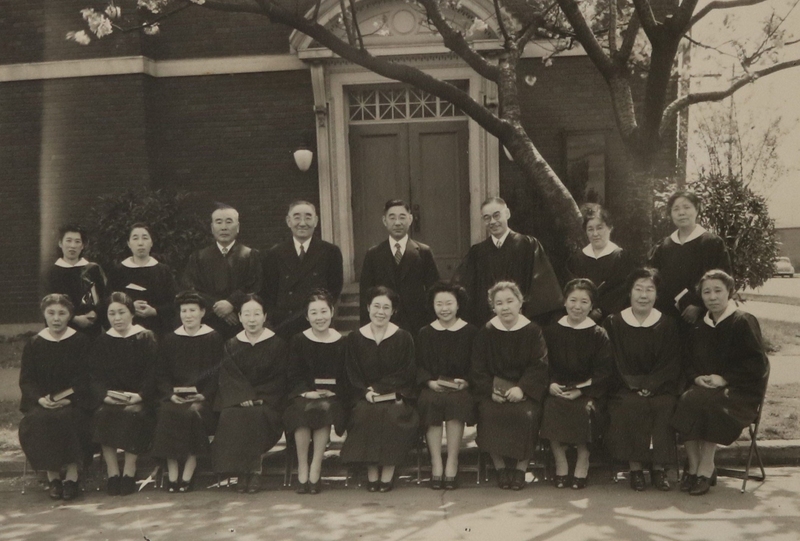
Rev. Masahiko Wada (center back) was among the pastors who served the Seattle Nichigo (Japanese-language) Combined Church in 1945-1946.
After the War
Japanese Baptist congregations dealt with challenges similar to those faced by their individual members. The Terminal Island and Winslow churches both lost not only their buildings, but also their entire prewar community infrastructure, and never reopened. Other churches, like Los Angeles Japanese Baptist, found that their buildings had been given to use by other congregations, and relocated to new locations. The upheaval of the war and postwar years ensured that even where a church successfully reopened, it was indelibly changed by the loss of past members and the arrival of new ones.
In the immediate postwar years, Japanese American Baptists also faced a specific challenge from their own denomination. Observing the violence of World War II, as well as the incarceration of Japanese Americans and the relative success of the federated churches, leaders in many Protestant denominations became increasingly skeptical of the “ethnic” churches that had grown out of prewar mission work. Home missions and ecumenical church organizations in California and Washington considered a strategy of encouraging Nisei to integrate into white-majority congregations, while organizing Issei into Japanese-language congregations based on the federated church model. These suggestions were met with resistance by most Japanese Americans and many individual home missionaries, who pointed to continuing anti-Japanese sentiment among whites; Japanese American Baptists were also vocal in demanding congregational self-determination. Their arguments ultimately won the day, but the controversy delayed the reopening of some Japanese churches by several years.
For the Japanese people there was never a question of whether their churches would be [re]opened. There was no doubt about it, they would be going back to their own…they had been pushed around, deprived of freedom, and put behind barbed wire fences. The church back home was the only thing left in which to trust.
Later in the same correspondence he pointed out the continuing impact of anti-Japanese racism, and how compelling assimilation would make the church less welcoming for Japanese Americans:
Caucasian church leaders argue that if these boys and girls can go to public school with caucasians, they can go to church or Sunday school together. Sounds good, but everyone is compelled to go to public school even if someone throws a rock, spits in your face, or calls you a dirty Jap. One is not compelled to go to Sunday school
A Living Legacy
The wartime incarceration of Japanese Americans has had a lasting impact on American Baptist life at multiple levels. The experience was formative for Nisei Baptists who became denominational leaders, most notably Revs. Jitsuo Morikawa and Paul Nagano: Morikawa had a long career as an ABCUSA executive and played a key role in developing Baptist civil rights and environmental justice work, while Nagano was a founder of the Japanese Evangelical Mission Society (JEMS); both were also among the founders of the Asian American Baptist Caucus (now the Alliance of Asian American Baptist Churches) in 1971. Several students who recieved support from the ABHMS during the war also went on to become leaders, such as Rev. Roy Ishihara and missions volunteer Tai Shigaki.
The memory of incarceration has also continued to shape Japanese Baptist congregations long after the war and its immediate aftermath. While Japanese American communities avoided discussion of the incarceration in the immediate following decades, the late 1970s and 1980s saw the emergence of a movement for redress and reparations, led mainly by younger Nisei and Sansei (third-generation), many of whose parents came of age behind barbed wire. Japanese churches were among the community organizations that preserved the best records of incarceration and its effects, and served as centers for organizing in the redress movement. In the present day, the memory of incarceration continues to inform these congregations' social values.

In 1947 First Baptist Church of Chicago called Jitsuo Morikawa as its head pastor, making him the first Asian American to lead a historically white-majority church.

Evergreen Baptist Church in Los Angeles was among the Japanese American congregations whose members were active in the redress movement of the 1980s.