Forced into Exile
Following the bombing of Pearl Harbor on December 7, 1941, Japanese Americans and Japanese migrants in the United States face increased suspicion and discrimination, particularly on the west coast. President Roosevelt immediately invoked the Alien Enemies Act to authorize the arrest and detention of Japanese, German, and Italian non-citizens. Many Issei leaders, including pastors and teachers, were arrested and sent to internment camps. Roosevelt eventually signed Executive Order 9066 on February 19, 1942, authorizing military commanders to create “military areas” from which “any or all persons may be excluded,” thus opening the way for the removal of all people of Japanese descent from most of California, Oregon, and Washington. On March 2, 1942, General John DeWitt of the Western Defense Command created two military areas encompassing California, Oregon, Washington and Arizona. Over the following five months, more than 112,000 people were forced to leave their homes with only what they could carry.
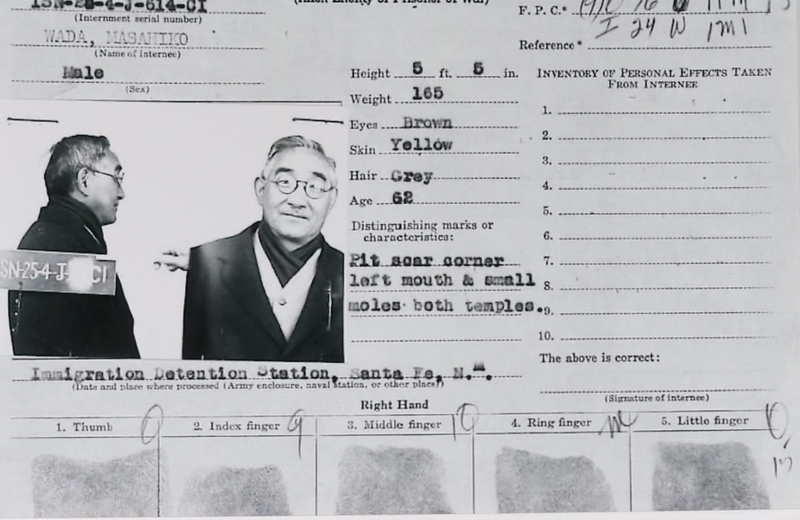
Issei pastor Masahiko Wada and his wife were both arrested and sent to DOJ Internment camps before eventually being reunited with family at Amache after ABHMS leaders intervened on their behalf.
Terminal Island
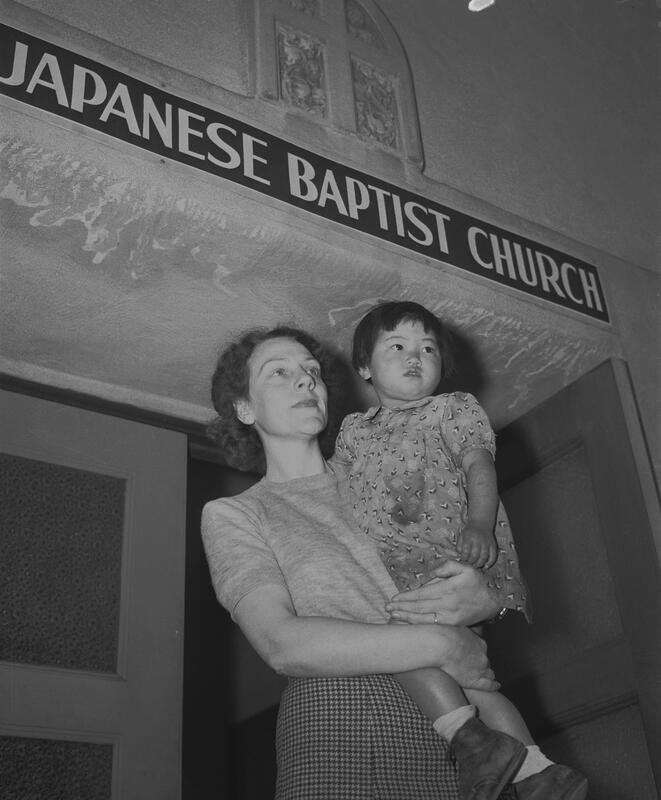
Virginia Swanson, missionary of the Women’s American Baptist Home Mission Society, carries a young girl during the evacuation of Terminal Island, Feb. 1942.
Southern California was home to the largest community of Japanese people in the United States. Migration from Japan had increased after the Chinese Exclusion Act of 1882 and many settled in the Los Angeles area to work in the fishing or agricultural industries. The Los Angeles Baptist City Mission Society began work with the Japanese community in the farming community of Moneta (now Gardena) in 1914. A second mission was opened in the fishing village on Terminal Island in San Pedro in 1917 and a third in the Boyle Heights neighborhood in 1925. By 1941, there were six full-time and two part-time Japanese ministers on staff. Two churches, Japanese Baptist (Gardena) and Boyle Heights, had become sufficiently self-supporting to be admitted as full members of the Los Angeles Baptist Association in 1941.
After the attack on Pearl Harbor, many of the fisherman on Terminal Island were arrested and the fishing boats seized. Before the general evacuation orders, people in the fishing village on Terminal Island in San Pedro were ordered to leave their homes within 48 hours. On February 25, less than a week after the signing of Executive Order 9066, those remaining on Terminal Island were given 48 to evacuate their homes and be off the island. Baptist missionaries and others helped many find temporary housing until they were moved to incarceration camps like Manzanar.
"The women packed through the night, but when the trucks came the next morning, some were not done...but we had to take them, ready or not. In some cases, we had to pull them from their houses crying and rush them off…In one case the hostel was not at all prepared…The residents had no light, no gas, no water. But before the 48 hours were up, so far as I know, every Japanese was off the island…"
-Virginia Swanson Yamamoto, "Terminal Island Days"
Bainbridge Island and Seattle
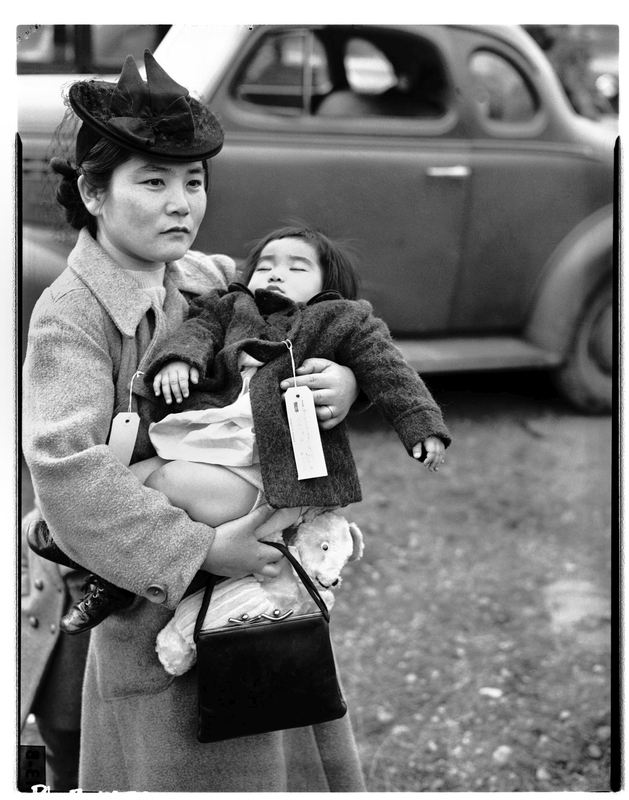
Fumiko Hayashida, a native of Bainbridge Island, Washington, holds her daughter as she waits to board a ferry during the evacuation on March 30, 1942. Her youngest child was born a few months later at Manzanar War Relocation Center.
Before World War II, Seattle had the second largest concentration of Japanese migrants. They worked in canneries, railroad, logging and, like those in California, agriculture. In March, 1893, the American Baptist Home Mission Society appointed the missionary to Seattle as principal of the mission school that had begun at First Baptist Church. Seattle Japanese Baptist Church was organized in 1899 with Rev. Fukumatsu Okazaki as pastor. In 1904, the Fujin Home for Japanese women was established. By 1941, the church was a thriving community with missions in Bellevue and Tacoma.
On Bainbridge Island, Rev. Kihachi Hirakawa pastored the Winslow Baptist Church which called the Winslow Lighthouse. He had first come to the Seattle area in 1890 and worked in the sawmill in Port Blakely. Becoming a minister at the age of 50, he left Washington for Missouri, then Illinois, to pursue an education before returning to Bainbridge Island to build the Baptist Church in Winslow. He was 78 when Bainbridge Island became the first community evacuated under the general order. The rest of Seattle was evacuated a few weeks later. The Bainbridge Islanders were first taken to Manzanar in California, with those in Seattle going to Minidoka in Idaho. Emery Andrews, John Thomas and others advocated for the Bainbridge Islanders to be transferred and they were eventually reunited with the Seattle congregation.