Nurturing Faith
Of the many ways that incarcerated Japanese Americans tried to preserve aspects of normal life in the camps, religion was among the most prominent. Buddhist, Protestant, and Catholic congregations worked to continue holding services and organizing community events as they had before incarceration.
Like every other aspect of incarcerated life, religion in the camps was heavily constrained. The WRA guaranteed religious freedom in principle, but with significant restrictions in practice. Religious activities were subject to surveillance, religious texts written in Japanese were initially banned, and Shinto-related practices were forbidden entirely due to their association with the Japanese government. There were also practical material constraints. Space and resources for religious practices were extremely limited, with even the permanent camps offering only a single dedicated structure for religious services.
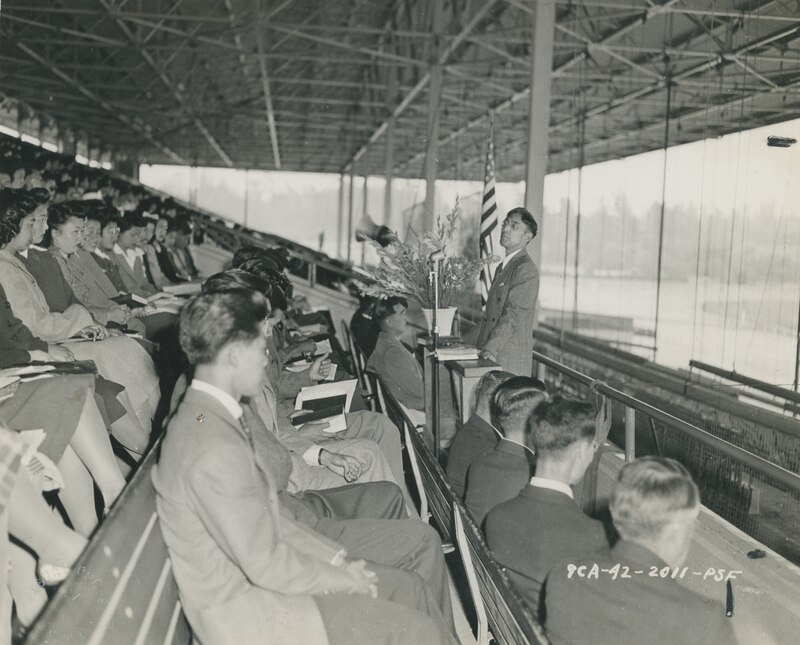
The Federated Protestant Church holds a service in the racetrack stands at the Santa Anita Assembly Center.
The Federated Churches
To manage the limited resources available–and to make religious activities easier to surveil–the WRA required Buddhists, Protestants, and Catholics in each camp to operate as single groups across congregational and sectarian lines. The major Protestant denominations, including the Northern Baptists, organized their members into “federated”, “ecumenical,” or “union” churches. Within these churches, clergy and members of different congregations worshipped together, jointly organized events, and shared resources received from their parent denominations. At the same time, Japanese Americans continued to maintain the social ties of their preexisting congregations, and denominations continued to work closely with their own members while also sharing responsibilities.
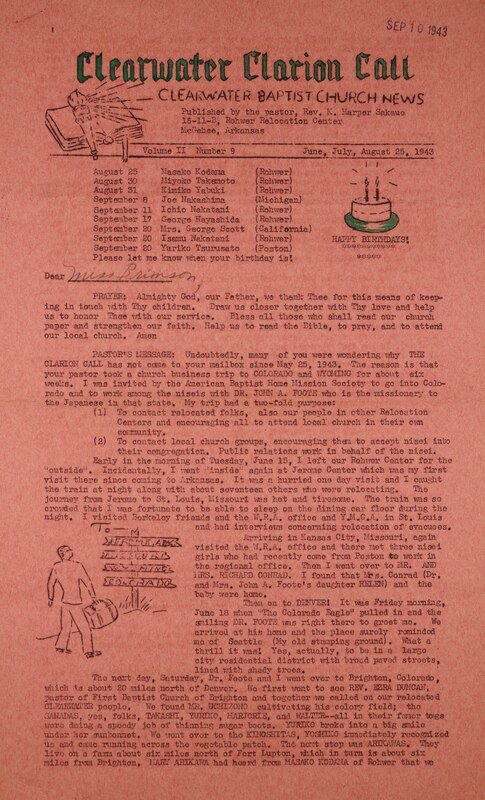
Rev. Harper Sakaue of Pasadena’s Clearwater Nisei Baptist Church continued publishing the church bulletin for his incarcerated congregation, while also serving the Federated Church at Rohwer.
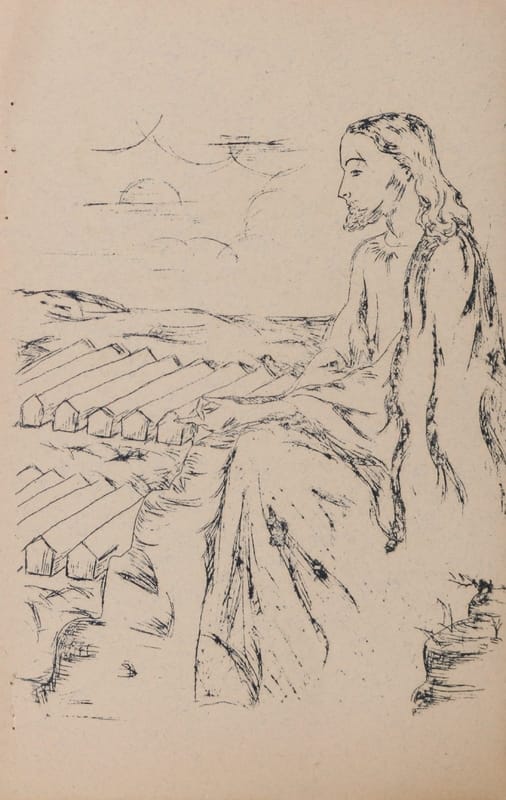
The Federated Church at Poston published a collection of devotionals, illustrations, and testimony titled “Meditation Moments,” in 1943. Baptist contributors included Revs. Paul Nagano, future home missionary Kayoko Asai, and future pastor Roy Ishihara.
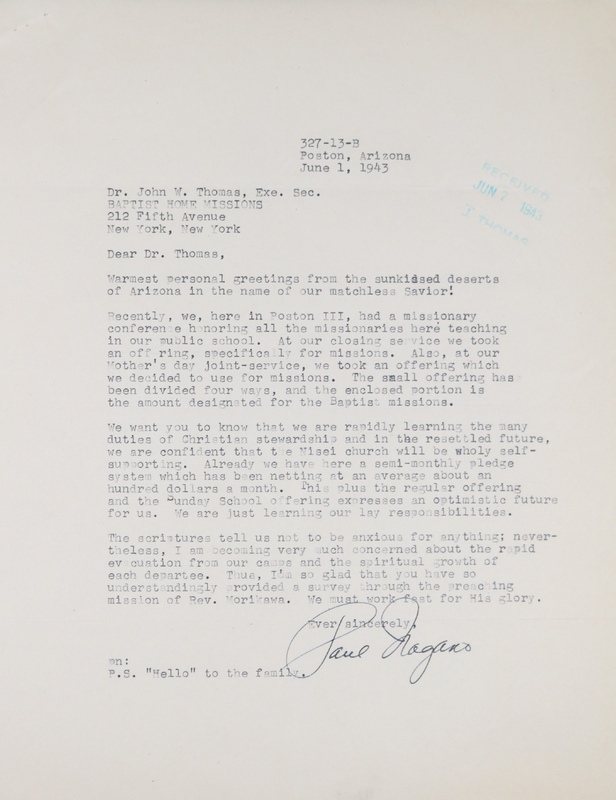
In a letter to John Thomas, Paul Nagano discusses the collection of an offering to support missions at Poston. Japanese Americans took an active role in home missions work, despite the significant material constraints of incarceration.
Pastoral Care
Incarcerated pastors were the leaders of the federated church programs and faced a complex set of responsibilities. Pastors balanced serving the interdenominational communities of the federated churches with their responsibilities to their own congregations, though some pastors–like Gardena’s Masahiko Wada, who was sent to Amache after being released from Justice Department custody in 1943–found themselves working with new populations. They also had to negotiate the different needs and attitudes of Issei and Nisei incarcerees. English-language preaching and pastoral skills were in particularly short supply, as most Japanese American pastors prior to the war were Issei who worked primarily in Japanese. Even with the federated church structure in place, shortages of resources and personnel required many pastors to seek permission to travel between camps.
The need for English-language ministry in the camps was formative for a younger generation of Japanese American clergy, mostly Nisei, who found themselves thrust into positions of increased responsibility. Baptists in this category included the established pastors Jitsuo Morikawa and Harper Sakaue, as well as the students/recent graduates Paul Nagano, Tom Fukuyama, and Yasushi Wada, who were all ordained during or shortly after the war. These pastors played a major role as representatives of Japanese American Christians to the wider US population.
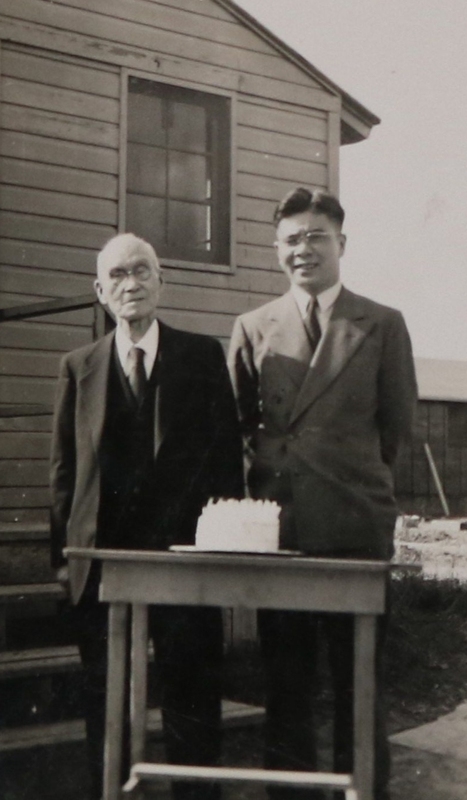
Revs. Kihachi Hirakawa and Tom Fukuyama, himself a member of Hirakawa's Winslow Baptist Church on Bainbridge Island, at a celebration of Hirakawa's 81st birthday at Minidoka.